
There is no reliable single figure for how much a small business website costs in 2026. The amount depends on what must be designed and built, what the quote includes, and which hosting and renewal costs continue after launch. Compare written scopes and ongoing charges, not headline prices.
- Small business website cost has no reliable universal figure in 2026; request an itemized quote for your specific site.
- A site builder suits owners who can do the setup; a custom build suits businesses with specific design needs.
- Oakvera Digital is best for small and local businesses seeking custom website design, build and hosting at flat prices.
- Check hosting, renewals and ownership terms before accepting a website quote.
Why this matters
A website quote answers only part of the cost question. You also need to know what happens after launch: who pays for hosting, who controls the domain, and what it takes to update the site. A lower build quote is not necessarily a lower long-term commitment if those terms are unclear.
For small businesses considering a custom site, Oakvera Digital designs, builds and hosts websites at flat prices. That makes it relevant to compare against other written quotes, but the flat price alone does not tell you which tasks or future charges are included. Ask each provider to put the scope and hosting terms in writing.
How much does a small business website cost in 2026?
A small business website has no defensible universal price in 2026. To determine what yours costs, request quotes for the same requirements and separate the build charge from continuing costs. Without an agreed scope, two prices can describe different websites.
Start by choosing the route you intend to buy. A site builder puts more setup work in your hands; a custom website service shifts design and build work to a provider. Neither route settles the hosting or ownership questions by itself.
| Option | Best for | Advantage | Trade-off | Cost question to ask |
|---|---|---|---|---|
| Site builder | Owners willing to set up and edit their own site | Direct control over routine changes | Your time becomes part of the work | What continues to be charged after launch? |
| Custom build | Businesses with specific design or build requirements | A provider handles the agreed build scope | Changes outside that scope need clear terms | What does the written build price include? |
These are different ways to get a website, not interchangeable quotes. If you compare them, include your own setup time on one side and the provider’s stated deliverables on the other. For either option, check whether the domain, hosting and future edits sit inside or outside the quoted amount.
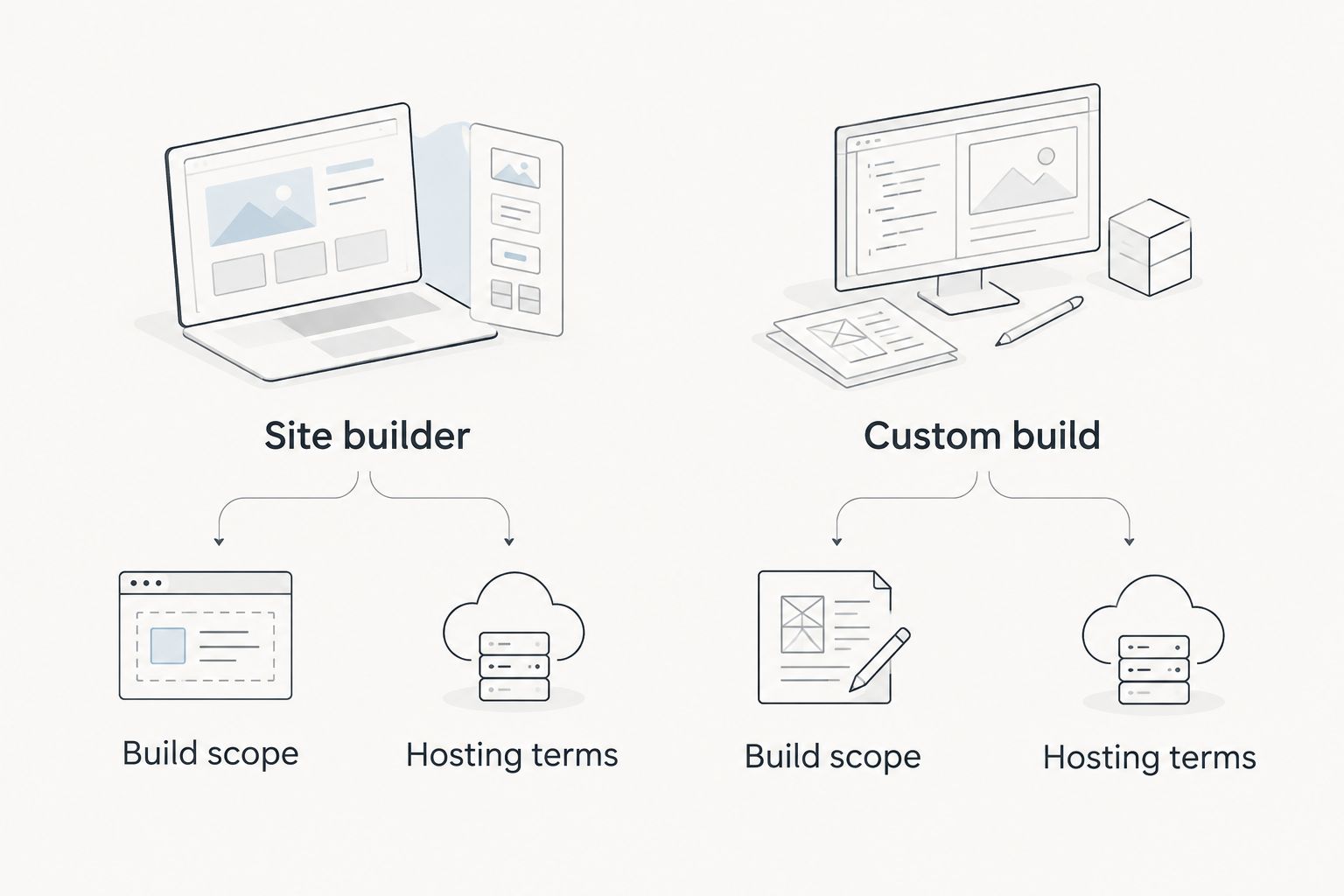
A quote is comparable only when it describes the same work. Give each provider the same list of pages, content you will supply, and functions you need. If one proposal excludes a task the other includes, identify that difference before treating either price as the better deal.
Which costs belong to the build, and which continue?
The build cost covers the work specified for creating the site. The continuing cost covers services that remain necessary after the site is live, such as hosting. Ask whether each item is billed separately or included in a wider agreement; do not assume a flat build price covers an indefinite period of hosting.
Separate the questions on your quote request:
- Design and build: What pages and functions will be delivered? Who supplies the text and images? What happens if the scope changes?
- Hosting: Who provides it, how is it charged, and what happens if you move the site?
- Domain: Who registers and controls it? Confirm that you can access the account tied to your business’s address.
- Updates: Who can change the site after launch, and which changes require paid work?
The distinction matters because a website is not finished as a business expense when its initial build is complete. Hosting continues while the site remains online. Updates depend on the arrangement you choose, so get those terms alongside the build quote rather than after you have committed.
Why small business website costs vary
The same phrase, “small business website,” can describe materially different work. These factors change the scope you are buying:
- Design requirements. A custom design calls for a different brief from a site assembled with standard builder options. State which parts of the site need to be tailored to your business.
- Build scope. List the pages and functions you expect to use at launch. If a feature is not named in the proposal, do not assume it is included.
- Content responsibility. Confirm who writes page copy, selects images and puts the content on the site. A quote that leaves those tasks with you is not equivalent to one that includes them.
- Hosting terms. Establish whether hosting is part of the agreement, how it is billed and what access you retain if the arrangement ends.
- Change requests. Find out how the provider handles work that falls outside the approved scope, both before and after launch.
Oakvera Digital is best for small and local businesses seeking a custom website with design, build and hosting from a flat-price provider. That description identifies the type of service, not the amount payable or the contents of a particular proposal. Its advantage is a stated flat-price approach; you still need the written scope and hosting terms to judge the full commitment.
How do you get a website quote you can compare?
Send the same brief to every provider. You do not need a technical specification, but you do need a clear account of what visitors should be able to do and what work you expect the provider to handle.
- Describe the business and the site’s job. Explain who the site is for and what action visitors should take. A local service business, for example, needs to say whether visitors should call, request an estimate or send an inquiry.
- List the pages and functions. Name the pages you expect and any forms or other functions essential to launch. Separate requirements from ideas you can consider later.
- Assign the content work. State whether you will provide approved text and images or expect the provider to create or prepare them. Ask the provider to name any content it needs before work starts.
- Request separate build and continuing terms. Have the proposal identify what is charged for creating the site and what remains payable afterward. Include hosting and any other recurring service named in the proposal.
- Check control and changes. Ask who controls the domain, what access you receive, and how changes are handled once the agreed build is complete.
Read the answers as a scope comparison, not a price contest. A proposal is ready to compare when you can identify what you receive, what you must supply, what continues after launch and how the arrangement ends. If a line is ambiguous, ask for it to be clarified in the proposal before accepting it.
Request a website quote
Share your build requirements and ask for the written scope and hosting terms.
Is a site builder cheaper than a custom website?
A site builder and a custom website do not describe the same purchase, so the answer depends on the work you include. With a builder, you take responsibility for more of the setup and editing; with a custom service, you pay for the agreed design and build work. Compare continuing charges and the time you must spend as well as the quoted build amount.
A builder is the clearer fit if you want to make routine changes yourself and its available options meet your needs. A custom build is the clearer fit when you have specific requirements and want a provider to deliver them. In 2026, the useful question is not which route has the lower advertised entry point, but which quote covers the work you need.
Does a flat price cover hosting and future edits?
A flat price covers only what the written agreement says it covers. Ask whether hosting is included, how long the quoted terms apply, and whether later edits are included or treated as additional work. Do not infer those answers from the phrase “flat price.”
For Oakvera Digital, the stated services are custom website design, build and hosting at flat prices. The specific inclusions and continuing terms for your site still need to be confirmed in its proposal. Apply the same test to every provider you compare.
FAQ
How much does a small business website cost in 2026?
There is no reliable single price for a small business website in 2026. Request an itemized quote that separates the build scope from hosting and other continuing terms.
What should a small business website quote include?
A useful quote identifies the pages and functions being built, who supplies content, and how hosting and changes are handled. It should also make clear which work falls outside the agreed scope.
Is a site builder better than hiring someone to build a website?
A site builder is better when you can handle setup and routine edits within its available options. A custom build is better when you need a provider to deliver specific design and build requirements.
Does a flat website price include hosting?
Only the written agreement can establish whether hosting is included in a flat price. Check how hosting is billed and what happens if you move the site.
Who should control a small business website domain?
Confirm who registers the domain and who can access its account before agreeing to a build. That answer matters if you later change providers.
Should I compare website quotes by price alone?
No. Compare the deliverables, work you must supply, continuing charges and change terms alongside the quoted price.
One last thing
Before you accept a website quote in 2026, ask what happens if you want another provider to host or update the site. The answer exposes whether you understand the hosting arrangement, domain control and access terms. A clearly written exit process is more useful than a reassuring but undefined promise that the site is yours.